
What if the number staring back at you from your bathroom scale is actually sabotaging your progress? It's incredibly frustrating to put in the hard yards at the gym and eat well, only to see that stubborn needle refuse to budge. You've probably heard that muscle is denser than fat, but without a professional muscle and fat analysis, it's nearly impossible to tell if you're actually transforming your body or just spinning your wheels. Most home scales simply can't distinguish between a litre of water, a kilogram of muscle, or stored body fat.
We know how discouraging it feels when your effort isn't reflected in the numbers, but it's time to stop letting a blunt instrument define your success. This article will show you why total body weight is a poor metric for your health and how shifting your focus to body composition can revolutionise your fitness results. We'll explore how tools like the InBody 570 Body Composition Scan validate your hard work, why tracking visceral fat is vital for your longevity, and how a data-driven plan ensures every workout counts toward your specific goals.
Key Takeaways
- Stop letting the bathroom scale dictate your mood and understand why "body recomposition" is the true secret to looking and feeling leaner.
- Discover how a professional muscle and fat analysis identifies your Skeletal Muscle Mass, the essential engine that drives your metabolism and fat-burning potential.
- Learn why cheap home smart scales often provide misleading data and how professional-grade scans offer the accuracy you need to track real progress.
- Identify the critical health risks associated with visceral fat, the hidden fat around your organs that total body weight simply cannot measure.
- Find out how to use your unique scan data and Basal Metabolic Rate to organise a personalised nutrition and training plan that delivers measurable results.
The Weight Loss Myth: Why Your Bathroom Scales are a Liar
The daily ritual of stepping on the scales can be a mental minefield. You wake up feeling lean, have a cracker of a workout, and eat clean all day, only to see the number go up by half a kilo the next morning. It's enough to make anyone want to chuck the scales out the window. This psychological trap sabotages your motivation because it ignores the complex reality of what body composition is. Your total weight is just a single, blunt data point. It's a measurement that fails to account for the quality of your mass or the hard work you've put in at the gym.
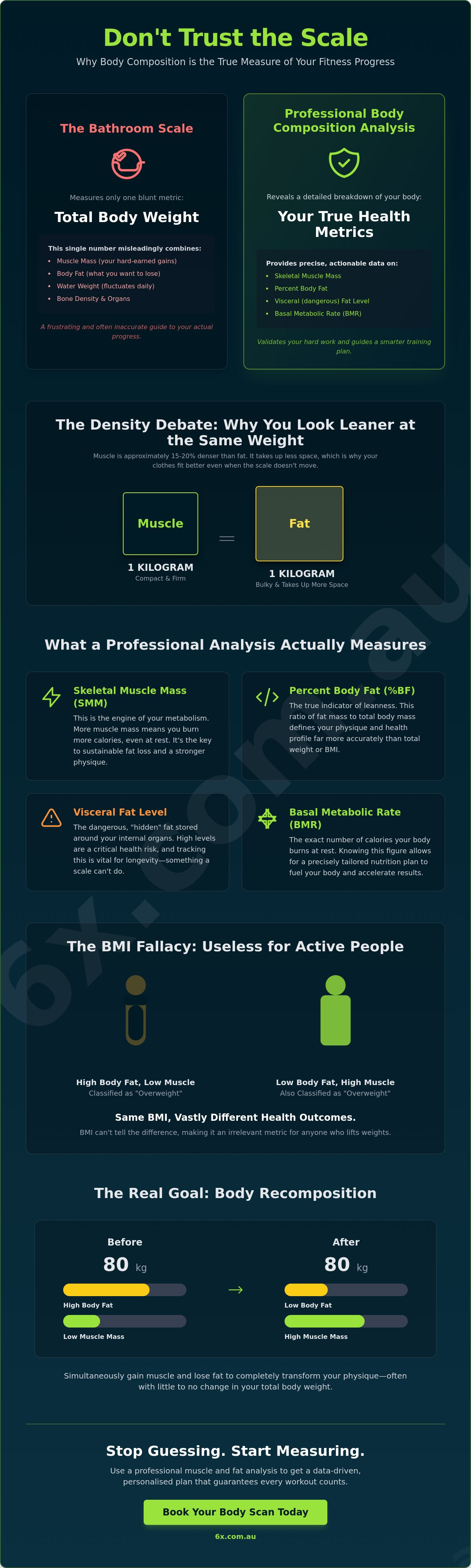
A professional muscle and fat analysis reveals what's actually happening under the hood. Consider the density debate. One kilogram of muscle is roughly 15% to 20% smaller in volume than one kilogram of fat. While they weigh exactly the same, muscle is compact and firm, whereas fat is bulky and takes up significantly more space. This is why your clothes might fit better and your waist looks smaller even if the scale hasn't budged. You're physically shrinking while becoming stronger, a shift that provides massive psychological relief once you see the data proving your muscle mass is climbing.
It's also vital to remember that your body is a dynamic system, not a static statue. High salt intake, intense training inflammation, or simple changes in hydration can cause your weight to swing by up to 2kg overnight. These fluctuations have nothing to do with fat gain, yet they drive many people to quit their programs prematurely because they feel they've failed. Using data to see past these temporary spikes is the only way to stay on track.
The Problem with BMI in the Eastern Suburbs
In active communities like Maroubra and Coogee, the Body Mass Index (BMI) is particularly useless. BMI only looks at the ratio of your height to your weight. This means a fit person with significant muscle mass is often classified as "overweight" or even "obese" by standard medical charts. It's a generic, outdated system that fails anyone who lifts weights. Instead of chasing a lower BMI, you should focus on your specific body fat percentage. Knowing your ratio through a muscle and fat analysis is the only way to ensure your training is moving you toward a healthier, leaner physique rather than just a smaller number on a chart.
The Myth of "Spot Reduction"
Many people start a new program hoping to melt fat specifically from their stomach or thighs. Unfortunately, you cannot choose where your body burns fat first; your genetics and hormones make that call. We call this the myth of spot reduction. While you can't pick the spot, an analysis identifies exactly where your body stores stubborn fat, allowing us to track how it leaves your system over time. This data allows us to focus on body recomposition, which is the simultaneous gain of muscle and loss of fat. This dual-action approach is the gold standard for long-term transformation and sustainable health.
Beyond the Number: What Muscle and Fat Analysis Actually Measures
A professional muscle and fat analysis doesn't just give you a different number; it provides a comprehensive map of your internal health. At the core of this data is your Skeletal Muscle Mass (SMM). Think of SMM as the engine of your body. The larger and more efficient the engine, the higher your Basal Metabolic Rate (BMR) becomes. Your BMR is the exact number of calories your body burns just to keep the lights on while you're resting. When we increase your muscle mass through structured training, we're essentially upgrading your metabolism, making fat loss more sustainable in the long run.
Understanding the difference between Body Fat Mass and Percent Body Fat is equally critical. You could lose three kilograms of fat, but if you also lose muscle, your body fat percentage might actually go up. This ratio is what defines your physique and your health profile. High levels of fat, particularly when stored internally, lead to the well-documented dangers of visceral fat, which can impact your metabolic health even if you appear thin on the outside.
We also look at Segmental Lean Analysis. This identifies exactly how muscle is distributed across your arms, legs, and torso. It's common to find imbalances where one side of the body is doing more work than the other. Identifying these discrepancies early allows our coaches to adjust your program, ensuring you build a balanced, injury-resistant body. If you're ready to see what's happening beneath the surface, our introductory program includes a full assessment to get you started.
Total Body Water and Oedema
One of the biggest reasons the bathroom scale lies is water retention. A professional muscle and fat analysis distinguishes between intracellular water (inside your cells) and extracellular water (the fluid that causes bloating). Heavy training sessions often cause temporary inflammation and oedema as your muscles repair. This isn't fat gain. It's a sign of recovery. By tracking these levels, we can tell if you're truly hydrated or if your body is holding onto fluid due to stress or diet.
Bone Mineral Content
For our older clients in Randwick and Malabar, monitoring Bone Mineral Content is a vital part of our wellness strategy. Bone density naturally fluctuates, but consistent resistance training is proven to strengthen the skeletal system. By tracking this data, we can monitor the long-term effectiveness of your training and ensure we're proactively protecting your mobility and independence as you age. It moves the conversation away from just looking good to truly functioning at your best for decades to come.
Comparing the Methods: DEXA Scans vs. InBody vs. Home Scales
Not all measurements are created equal. You might have spent $50 on a "smart scale" from the local shops, but these devices are often wildly inaccurate. Most home models use a single, weak electrical frequency that barely travels past your legs, leading to massive inconsistencies. If you're serious about your results, you need a professional muscle and fat analysis that uses medical-grade technology rather than a consumer-level gadget. Relying on poor data is often worse than having no data at all because it leads to misguided changes in your training or diet.
DEXA scans are often called the clinical gold standard for body composition measurement techniques. They offer incredible precision, often within a 1% margin of error. However, they come with significant baggage. A DEXA scan involves low-level radiation, requires a trip to a specialist imaging centre, and can be quite pricey. For most people in Maroubra, the friction of booking an appointment and the high per-scan cost makes it impractical for regular, month-to-month tracking.
This is why we chose the InBody 570 for our studio. It uses multi-frequency Bioelectrical Impedance Analysis (BIA) to send different currents through your body. This allows it to measure intracellular and extracellular water separately, providing a far more nuanced picture than home scales. It gives you clinical-level data in about 60 seconds without the radiation or the hospital visit. It's the perfect balance of accuracy and convenience for anyone committed to a long-term transformation.
Why Clinical Accuracy Matters for Your Goals
Old-school skinfold calipers are notorious for human error. A slight slip of the hand or a different tester can change your result by several percentage points, leading to poor training decisions and unnecessary frustration. Professional tools like the InBody 570 provide repeatable, reliable data that removes the guesswork. When the data is consistent, your confidence grows because you know your progress is real. Learn more about our InBody Scan in Maroubra and how it can sharpen your focus.
Frequency of Testing
Checking your stats every day is a recipe for anxiety. We recommend a scan every 4 to 8 weeks. This timeframe is long enough to capture a genuine trend in your body composition rather than just a fleeting moment of hydration change. To ensure the most accurate results, always scan at the same time of day, ideally while fasted and before you hit the gym. This consistency allows us to see the true impact of your hard work and adjust your plan with precision. It's about looking at the big picture rather than getting bogged down in daily fluctuations.
Tracking Visceral Fat: The Hidden Marker of Longevity
Most of us focus on the fat we can see in the mirror. We pinch our waistlines or check our reflection, worrying about subcutaneous fat, which sits just under the skin. While this type of fat affects how our clothes fit, it's actually the fat we can't see that poses the greatest risk to our health. Visceral fat wraps around your internal organs, including your liver and kidneys. It's metabolically active, meaning it pumps out inflammatory markers that can damage your arteries and interfere with how your body processes insulin. A professional muscle and fat analysis is the only way to accurately measure this hidden danger.
This data is particularly important for those who fall into the "skinny fat" category. You might have a low total body weight and look lean in a t-shirt, but you could still carry dangerous levels of internal fat. Relying on a standard bathroom scale would suggest you're perfectly healthy, but your internal profile might tell a different story. At 6X Training, we prioritise visceral fat reduction because we're invested in your long-term health, not just your appearance. We use these metrics to prove that your training is making you healthier from the inside out.
The Health Risks of High Visceral Fat
High levels of internal fat are directly linked to metabolic syndrome, type 2 diabetes, and heart disease. Because visceral fat is so tucked away, it's a better predictor of cardiac events than total body weight or BMI. When you step on our scanner, you'll receive a specific "Visceral Fat Level" score. This number gives us a clear baseline to work from. To dive deeper into the science of these metrics, check out our complete guide to tracking internal health in 2026. It explains exactly how we interpret these scores to protect your longevity.
Reducing Internal Fat through Lifestyle
The good news is that visceral fat is often the first to go when you commit to the right lifestyle changes. Unlike subcutaneous fat, which can be stubborn, internal fat responds exceptionally well to high-intensity training and structured nutrition. We combine Personal Training with bespoke Nutrition Coaching to target these deep fat stores effectively. We also look at your sleep and stress management, as high cortisol levels are a primary driver of internal fat storage. We track this metric meticulously to ensure our Sydney clients are actually improving their biological age. If you want to find out your score and start a data-driven plan, our 6-week introductory program provides the perfect starting point.
Mastering Your Metrics: How 6X Training Uses Data to Guarantee Results
Data is just ink on a page unless you have a mentor to help you navigate it. While medical imaging centres might hand you a report and send you on your way, our coaches at 6X Training use your muscle and fat analysis as the foundation of your entire program. We don't guess your calorie needs; we use your Basal Metabolic Rate (BMR) to adjust your macronutrients with mathematical precision. If the scan shows you're carrying more muscle in your right leg than your left, we customise your training volume to fix that imbalance before it leads to a niggle or injury. This level of detail ensures you aren't just working hard, but working smart.
Our approach is built on a foundation of accountability and transparency. We offer a bold Results Guarantee because we use objective data to prove our methods work. When you can see your skeletal muscle mass increasing and your visceral fat levels dropping, you don't have to rely on subjective feelings or the deceptive number on a bathroom scale. If the numbers aren't moving in the right direction, we have the data to see exactly why and can pivot your strategy immediately. It's a structured, disciplined way to train that removes the emotional rollercoaster of wondering if your effort is paying off.
Your Personalised Transformation Roadmap
We use the InBody 570 to set realistic 8-week goals that are actually achievable for the average person. Our Maroubra members find this data-driven approach much more motivating than looking in the mirror. They can see their muscle mass climbing even when their reflection hasn't changed yet. This validation is vital for staying committed to the process. For a deeper dive into the science of these metrics, read our Body Fat Analysis Sydney: The Ultimate Guide to Body Composition and Results.
Book Your Analysis Today
Your first 15-minute scan and consultation is the moment you stop guessing and start knowing. You'll walk away with a clear understanding of your body and a scientific certainty about your next steps. There is no more room for confusion or plateauing when you have a clear map of your body composition. Book your Muscle and Fat Analysis at our Maroubra studio today and let's start building the results you've been working for.
Take Control of Your Transformation with Scientific Certainty
You no longer have to let a blunt number on a bathroom scale dictate your self-worth or your fitness strategy. Total body weight is a deceptive metric that ignores muscle growth, hydration shifts, and critical health markers like visceral fat. By shifting your focus to a professional muscle and fat analysis, you gain the clarity needed to ensure your hard work in the gym actually translates into the results you want. It's the difference between guessing and knowing exactly how your body is changing beneath the surface.
At 6X Training, we've been delivering proven results since 2011 by combining clinical-grade InBody 570 technology with expert interpretation from Sydney's leading fat loss coaches. We don't just hand you a report; we build a roadmap based on your unique biology and metabolic rate. It's time to stop the cycle of frustration and start training with data-driven confidence. Stop guessing and start tracking; book your InBody Scan at 6X Training Maroubra today. Your journey to a leaner, healthier, and more capable version of yourself starts with scientific certainty. We're ready to help you finally see the progress you've been working so hard to achieve.
Frequently Asked Questions
How accurate is professional muscle and fat analysis compared to a DEXA scan?
Professional muscle and fat analysis using the InBody 570 has a 98% correlation with DEXA scans, which are the clinical gold standard. While DEXA uses x-rays to measure tissue, our BIA technology uses multi-frequency currents to provide similar accuracy without radiation. It's a reliable, non-invasive alternative that allows for frequent tracking of your body composition without the hospital visit or high costs.
Do I need to be a member of 6X Training to get a body composition scan?
You don't need to be a member of our studio to access an InBody 570 Body Composition Scan. We welcome anyone from the Maroubra and wider Sydney community who wants to stop guessing and start tracking their health with scientific data. Simply book your session, and one of our coaches will walk you through your results so you can apply the data to your own training plan.
How often should I have my muscle and fat analysis performed?
We recommend having your analysis performed every 4 to 8 weeks to capture meaningful changes in your body composition. Scanning daily or weekly is often counterproductive because minor fluctuations in hydration or inflammation can skew the data. An 8-week interval provides enough time for your training and nutrition efforts to manifest as measurable increases in muscle mass and reductions in body fat.
Can I eat or drink before my InBody scan?
You should avoid eating or drinking for at least 2 to 3 hours before your scan to ensure the most accurate reading. Consuming food or large amounts of water can affect the electrical impedance, potentially leading to an overestimation of lean mass. For the best results, we suggest booking your scan in the morning while fasted and before you've started your daily exercise routine.
Will the analysis show me exactly how much muscle I have in each limb?
Yes, the InBody 570 provides a detailed segmental lean analysis that shows the exact amount of muscle in each arm, each leg, and your trunk. This is incredibly useful for identifying muscle imbalances or tracking recovery after an injury. Seeing this data allows our coaches to adjust your program, ensuring you build a balanced and functional physique rather than just increasing total body weight.
Is muscle and fat analysis safe if I have a pacemaker or am pregnant?
You cannot use the InBody scanner if you have an electronic medical implant such as a pacemaker. The device sends a low-level electrical current through the body which could interfere with the implant's operation. While there are no known health risks for pregnant women, we generally advise against scanning during pregnancy because the significant shifts in body water make the results difficult to interpret accurately.
Why does my home scale give me a different body fat percentage every time?
Home scales are often inconsistent because they typically use a single, low frequency that only travels through your lower body. They rely heavily on mathematical estimations rather than direct measurement. Factors like the time of day, your hydration levels, or even the surface the scale is sitting on can cause your body fat percentage to swing wildly. Professional analysis uses multiple frequencies to provide a stable, clinical-grade result.
How long does the actual scanning process take?
The actual scanning process on the InBody 570 takes approximately 60 seconds. However, we book 15-minute appointments to allow enough time for a thorough consultation. During this time, your coach will explain your metrics, including your visceral fat levels and basal metabolic rate, so you leave with a clear, actionable plan to improve your results. It's a quick process that provides a massive amount of valuable data.
Article by
Brad Ellison
Brad Ellison is a personal trainer, weight loss coach and founder of 6X Training in Maroubra, Sydney. Since 2006, he has helped clients across the Eastern Suburbs lose weight, build strength and improve their health through personalised fitness coaching, nutrition support and accountability. His expertise includes fat loss, body composition improvement, strength training and sustainable lifestyle change.


