

What if your standard bathroom scale is actually hiding the most important data point about your longevity? It's a common frustration to put in the hours at the gym and eat well, only to feel 'skinny fat' or remain confused by a visceral fat measurement that doesn't seem to budge. Most of us have been taught to obsess over a single number, but your total weight can't distinguish between the soft fat under your skin and the dangerous, hidden fat wrapped around your vital organs.
We know that you want more than just a guess when it comes to your wellbeing. Learning how to accurately monitor this internal metric is the essential bridge between looking fit and being truly metabolically healthy. This guide will teach you how to identify your internal health status and use professional tools to track your progress with absolute precision. We'll explore the best ways to monitor this 'hidden' fat and provide actionable steps to lower your scores through proven methods, from InBody 570 scans to expert nutrition coaching and structured personal training.
Key Takeaways
- Understand the 'Thin on the Outside, Fat on the Inside' (TOFI) phenomenon and why looking lean doesn't always guarantee internal health.
- Compare the accuracy and accessibility of different tracking methods, from clinical MRI scans to a professional visceral fat measurement using the InBody 570.
- Learn how high internal fat levels contribute to insulin resistance and cardiovascular risks, and why keeping your score under 10 is vital for longevity.
- Decipher the 1-20 scoring system to pinpoint exactly where you sit on the metabolic health spectrum and identify your 'Optimal Zone'.
- Discover how to transition from guesswork to a results-driven strategy using precise data, expert nutrition coaching, and structured personal training.
What is Visceral Fat and Why is Measurement Critical?
Not all fat is created equal. To truly understand your internal health, you need to look past the surface and identify What is Visceral Fat. Technically known as intra-abdominal adipose tissue, this is the fat stored deep within your abdominal cavity, wrapping around vital organs like your liver, heart, and kidneys. Unlike the subcutaneous fat you can pinch with your fingers, visceral fat is hidden from view, making it a silent but significant factor in your long-term wellbeing.
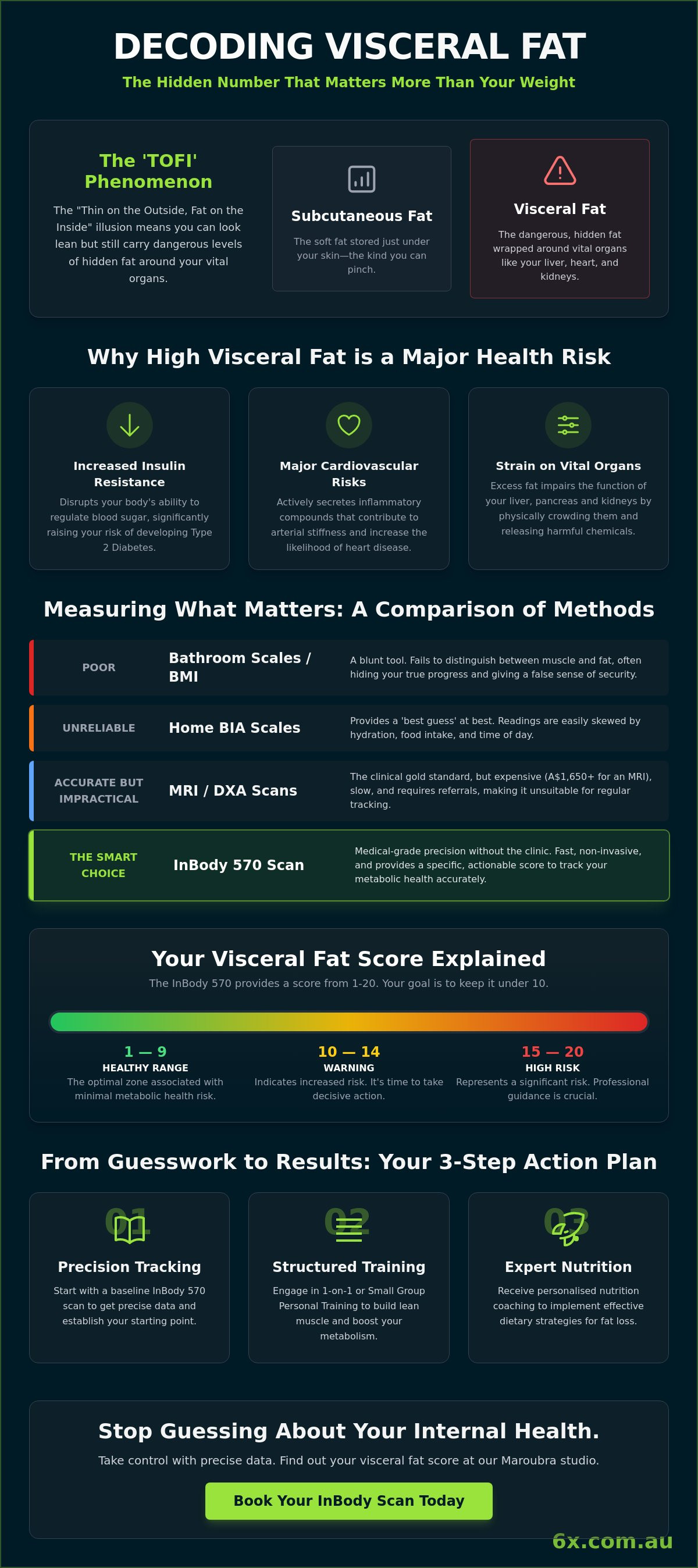
In fitness-conscious communities across Sydney’s Eastern Suburbs, we often encounter the 'TOFI' phenomenon: Thin on the Outside, Fat on the Inside. You might look lean in the mirror or maintain a healthy weight, yet still carry dangerous levels of internal fat that impact your longevity. This is why a professional visceral fat measurement is so vital. Relying on Body Mass Index (BMI) or a simple tape measure often provides a false sense of security. These methods only track volume and weight; they can't distinguish between healthy muscle and the metabolically active fat that puts your health at risk.
The Biological Function of Internal Fat
In very small amounts, internal fat serves a legitimate purpose by acting as a protective cushion for your organs. However, it becomes a hazard when it crosses a specific threshold. When these stores become excessive, the tissue transforms into an active endocrine organ. It starts secreting inflammatory cytokines directly into your system, which can lead to chronic inflammation and arterial stiffness. The metabolic tipping point is reached when these inflammatory secretions begin to disrupt your body's ability to regulate blood sugar and hormone levels effectively.
Why the Scales Lie About Your Progress
Your standard bathroom scale is a blunt tool that often hides your true progress. It provides a single, total number that fails to account for changes in your body composition. If you're engaged in a structured program like 1-on-1 Personal Training or Small Group Training, you'll likely be building lean muscle mass while losing internal fat. Because muscle is significantly denser than fat, your total weight might stay the same even as your health improves. Without a precise visceral fat measurement, you might feel frustrated by a stagnant scale number when, in reality, you're successfully reducing your risk of metabolic disease. Shifting your focus to body composition data is the only way to move from guesswork to a results-driven health strategy.
Comparing Visceral Fat Measurement Methods: MRI, DXA, and InBody Scans
When you're serious about tracking internal health, you need a method that provides more than just a vague estimate. Medical grade imaging, such as MRI and CT scans, remains the scientific baseline for accuracy. These tools allow clinicians to see exactly where fat is stored around your organs. However, for most Australians, the barriers are significant. An MRI can cost anywhere from A$1,650 to A$2,500; meanwhile, CT scans involve exposure to ionising radiation, making them unsuitable for frequent progress tracking. DXA scans are another high-accuracy alternative, but they often require a referral and a trip to a specialised radiology clinic, which isn't always practical for a busy lifestyle.
Bioelectrical Impedance Analysis (BIA) has emerged as the most accessible and practical solution for regular visceral fat measurement. It's important to distinguish between the cheap BIA scales you might find at a local chemist and professional-grade devices. Home scales often use a single-frequency current that can be easily skewed by your hydration levels or even the time of day. They provide a 'best guess' rather than a precise data point. To get a reliable reading, you need a multi-frequency system that can distinguish between intracellular and extracellular water to accurately map your tissue composition.
The Gold Standard for Maroubra Locals: The InBody 570 Scan
In our Maroubra studio, we utilise the InBody 570, which is widely recognised for its precision in a fitness setting. This device sends multiple electronic frequencies through the body to measure the resistance of various tissues. It doesn't rely on empirical estimations based on your age or gender; it measures you exactly as you are in that moment. The resulting report provides a specific 'Visceral Fat Level' score on a scale of 1 to 20. This allows you to move beyond the mirror and see the actual data behind your metabolic health. If you want to see where you stand, booking an InBody scan Sydney is the most efficient way to establish your baseline.
Traditional Methods: Waist-to-Hip Ratio and Calipers
Before advanced technology was widely available, we relied on manual proxies to estimate the dangers of visceral fat. You can calculate your waist-to-hip ratio at home by dividing your waist circumference by your hip measurement. According to Australian health guidelines, a ratio above 0.90 for men or 0.85 for women indicates abdominal obesity. While skinfold calipers are excellent for measuring subcutaneous fat, they are physically incapable of reaching the internal fat stored behind your abdominal wall. For a truly accurate visceral fat measurement, a tape measure simply cannot replace the depth of data provided by a professional scan. If you're ready to stop the guesswork, our team at the Maroubra training facility can help you interpret your results and build a plan to improve them.
The Hidden Dangers: Why High Visceral Fat Scores Impact Your Longevity
High visceral fat is more than just a storage issue; it's a metabolic hazard. While subcutaneous fat sits dormant under your skin, visceral fat is biologically active. It behaves like an extra organ that pumps out inflammatory chemicals. This is why a precise visceral fat measurement is crucial for longevity. Many people believe that a flat stomach equals a clean bill of health, but 'thin-on-the-outside' individuals can still carry significant internal fat. This hidden accumulation is directly linked to insulin resistance and Type 2 Diabetes, as the fat interferes with how your body processes glucose. Over time, this leads to chronic hypertension and increased arterial stiffness, placing immense strain on your cardiovascular system.
The danger lies in the proximity of this fat to your vital organs. When you're Interpreting Your Measurement, it's important to realise that these fat cells are constantly leaking substances into your bloodstream. This systemic inflammation is a primary driver of most age-related chronic diseases. It isn't just a physical burden; it's a chemical one that degrades your health from the inside out. By identifying these risks early, you can take proactive steps to protect your metabolic future.
Metabolic Syndrome and the Inflammatory Response
Visceral fat drains directly into the portal vein, which carries blood straight to your liver. This process floods the liver with free fatty acids, leading to a condition known as lipotoxicity. Lipotoxicity is the functional impairment of the liver and other organs caused by the accumulation of excess lipids. This metabolic chaos often manifests as persistent 'brain fog' or midday energy crashes. When your liver is overwhelmed by these fatty acids, your entire energy regulation system begins to falter, leaving you feeling sluggish regardless of how much sleep you get.
Hormonal Disruptions: Cortisol and Testosterone
Your hormones and internal fat exist in a feedback loop that can be difficult to break without the right strategy. Chronic stress triggers the release of cortisol, a hormone that explicitly tells your body to store fat in the abdominal cavity. For men, high levels of visceral fat are particularly damaging as they are closely associated with lowered testosterone levels. This creates a cycle where low testosterone makes it harder to maintain muscle, which in turn makes it easier to gain more internal fat. Breaking this cycle requires more than just 'eating less'. Engaging in structured fat loss training Sydney helps rebalance these hormonal signals. By combining resistance training with regular visceral fat measurement, you can effectively lower cortisol and support healthy hormone production for long-term vitality.
Interpreting Your Measurement: What Your Visceral Fat Level Actually Means
Once you step off the scanner, the data provides a clear roadmap for your health journey. The InBody system quantifies your internal health using a 1 to 20 scale, which is far more precise than a standard waist measurement. Staying between Level 1 and 10 is the 'Optimal Zone' for longevity. If your visceral fat measurement lands between 11 and 15, you're in the 'Caution Zone'. This score suggests your body is starting to store fat around your organs, which increases your metabolic risk. Scores from 16 to 20 represent the 'High Risk Zone'. At this level, internal fat is likely actively contributing to systemic inflammation and needs immediate attention.
If your score is above 10, don't panic; it's simply a signal that your current lifestyle isn't supporting your long-term metabolic goals. Use this checklist to begin your shift back toward the Optimal Zone:
- Review your daily sugar and processed carbohydrate intake to lower insulin levels.
- Increase the frequency of resistance training to improve muscle density.
- Prioritise 7 to 8 hours of quality sleep to manage cortisol production.
- Schedule a follow-up scan to track your downward trend.
The first step to improvement is knowing your starting point. You can book your baseline InBody 570 scan at our Maroubra studio today to see where you sit on the 1 to 20 scale.
Setting Realistic Reduction Targets
Internal fat is often the first to go when you implement the right strategy. Because it's so metabolically active, it responds much faster to exercise and nutrition changes than the stubborn fat under your skin. Working with a 1 on 1 personal trainer Sydney allows you to create a program specifically designed to mobilise these deep stores. We typically recommend a follow-up visceral fat measurement every 8 to 12 weeks. This timeframe is long enough to see significant physiological changes but short enough to keep you accountable and motivated by your data-driven progress.
Lifestyle Levers to Lower Your Score
High-intensity resistance training is your most powerful tool for reducing internal fat. It creates a 'metabolic fire' that continues to burn energy long after your session ends. While 'spot reduction' is a myth, certain types of training are more effective at targeting the hormonal environment that drives abdominal fat storage. In Maroubra's fast-paced environment, stress management is just as critical as your time in the gym. High cortisol levels from work stress or poor sleep hygiene can keep your visceral fat levels elevated even if you're eating well. Focusing on your recovery through tools like an infrared sauna or ice bath can help lower stress markers and support your fat loss journey.
How 6X Training Uses Data to Optimise Your Fat Loss Journey in Maroubra
At 6X Training, we operate on a simple but powerful philosophy: if you aren't measuring, you're guessing. This data-driven approach is the foundation of every transformation we lead in the Eastern Suburbs. We don't rely on the arbitrary number on a standard bathroom scale, which fails to account for muscle mass or internal health. Instead, we use the InBody 570 as a non-negotiable baseline for every new member. A visceral fat measurement is often the most revealing part of this initial assessment. It allows us to see exactly what is happening beneath the surface and identify the metabolic risks that a mirror simply cannot show.
Our personal trainers use this specific data to move beyond generic workout plans. When we know your exact visceral fat score, we can customise your training and lifestyle protocols with surgical precision. If your score is in the 'High Risk Zone', our focus shifts toward mobilising those internal stores through specific metabolic conditioning and resistance training. We don't just want you to look better; we want to ensure your internal 'engine' is functioning at its peak for years to come. This commitment to accuracy is why our members achieve results that are both visible and scientifically verified.
Customised Coaching Based on Your Internal Health
Our coaching team integrates your visceral fat measurement into a holistic strategy that includes 1-on-1 Personal Training and Small Group Training. If your internal fat levels are elevated, we often adjust training intensity to manage your central nervous system and avoid excessive cortisol spikes. This is paired with expert nutrition coaching to identify the dietary habits that may be fueling internal inflammation. Regular re-scans at our Maroubra centre provide a clear evidence trail of your progress. There is no better motivation than seeing your visceral fat level drop from a 12 to an 8 on a digital report, knowing your risk for chronic disease is plummeting alongside it.
The 6X Recovery Suite: Sauna and Ice Baths
The battle against internal fat isn't won solely through high-intensity effort. Because we know that chronic stress and elevated cortisol are primary drivers of visceral storage, we've built a world-class recovery suite to help you manage these hormonal triggers. Accessing a sauna and ice bath near me in Maroubra is a strategic advantage for your metabolism. Infrared saunas help lower systemic inflammation and improve circulation, while ice baths can stimulate 'brown fat' activity. Brown fat is a specialised tissue that burns energy to produce heat, helping to improve insulin sensitivity. We invite you to visit our Maroubra studio for a comprehensive health assessment and discover how a data-led approach can finally put you in control of your metabolic future.
Take Control of Your Metabolic Future Today
Your journey toward longevity begins with understanding what's happening beneath the surface. We've established that visceral fat is the silent metric that defines your internal health, and that the 'TOFI' phenomenon is more common than many realise. Relying on a standard scale only tells part of the story. A professional visceral fat measurement provides the clarity you need to move from guesswork to a data-driven strategy that actually works.
Since 2011, 6X Training has been Maroubra's leading fat loss specialist, helping locals achieve sustainable transformations. Our expert trainers specialise in metabolic health and utilise medical-grade InBody 570 technology to map your progress with absolute precision. We combine this high-level data with structured training and recovery protocols to ensure you reach the 'Optimal Zone' for your wellbeing.
Don't leave your health to chance. Book Your InBody Scan and Assessment at 6X Training Maroubra Today and take the first definitive step toward a healthier, more vibrant future. We're ready to partner with you on this journey.
Frequently Asked Questions
How often should I get a visceral fat measurement scan?
You should aim for a scan every 8 to 12 weeks to monitor your progress effectively. This timeframe provides enough space for your nutrition and training efforts to manifest as measurable physiological changes. Frequent scanning ensures you remain accountable to your goals while allowing our trainers to fine-tune your program based on real-time data.
Can I have high visceral fat if I have a low BMI?
Yes, it's entirely possible to have a low BMI while carrying dangerous levels of internal fat. This is known as the 'Thin on the Outside, Fat on the Inside' (TOFI) phenomenon. Because BMI only calculates your total weight against your height, it cannot distinguish between lean muscle and the fat wrapped around your organs. A professional visceral fat measurement is the only way to see the true state of your internal health.
Is visceral fat harder to lose than regular belly fat?
Visceral fat is actually more metabolically active than the subcutaneous fat found just under your skin. This means it often responds more quickly to high-intensity resistance training and improved nutrition. While it poses a greater health risk, it's frequently the first type of fat your body mobilises when you follow a structured fat loss program.
What is a healthy visceral fat level on an InBody scan?
A healthy visceral fat level on an InBody 570 report is a score between 1 and 10. This range is considered the 'Optimal Zone' for metabolic health and longevity. Once a score reaches 11 or higher, you enter the 'Caution' or 'High Risk' zones, which are associated with increased markers of systemic inflammation and cardiovascular strain.
Does stress really make you store more visceral fat?
Stress plays a significant role in how your body distributes fat. When you're under chronic stress, your body releases cortisol, a hormone that explicitly signals your system to store fat in the intra-abdominal area. Managing your stress levels through recovery tools like our infrared sauna and ice bath is just as important as your time spent lifting weights.
Can I measure visceral fat at home accurately?
It's very difficult to measure internal fat accurately with home-grade equipment. Most consumer scales use a single-frequency current that is easily influenced by your hydration levels or the time of day. Professional devices like the InBody 570 use multi-frequency currents to provide a reliable visceral fat measurement that distinguishes between water, muscle, and different types of fat.
How does the InBody 570 differ from a standard gym scale?
The InBody 570 uses advanced bioelectrical impedance analysis to map your body composition in segments. Unlike a standard gym scale that only provides a total weight, the InBody 570 measures the resistance of your tissues to multiple electronic frequencies. This allows it to provide a detailed breakdown of your muscle mass, hydration levels, and internal fat stores with medical-grade precision.
Where can I get a professional visceral fat scan in Maroubra?
You can get a professional body composition assessment at 6X Training in Maroubra. We've been the leading fat loss specialists in the area since 2011 and use the latest InBody technology to support our members. Our facility is designed to provide a welcoming environment where you can access expert guidance and advanced recovery tools in one location.

Article by
Brad Ellison
Brad Ellison is a personal trainer, weight loss coach and founder of 6X Training in Maroubra, Sydney. Since 2006, he has helped clients across the Eastern Suburbs lose weight, build strength and improve their health through personalised fitness coaching, nutrition support and accountability. His expertise includes fat loss, body composition improvement, strength training and sustainable lifestyle change.


