

Beyond the Scale: What Body Fat Percentage Actually Means
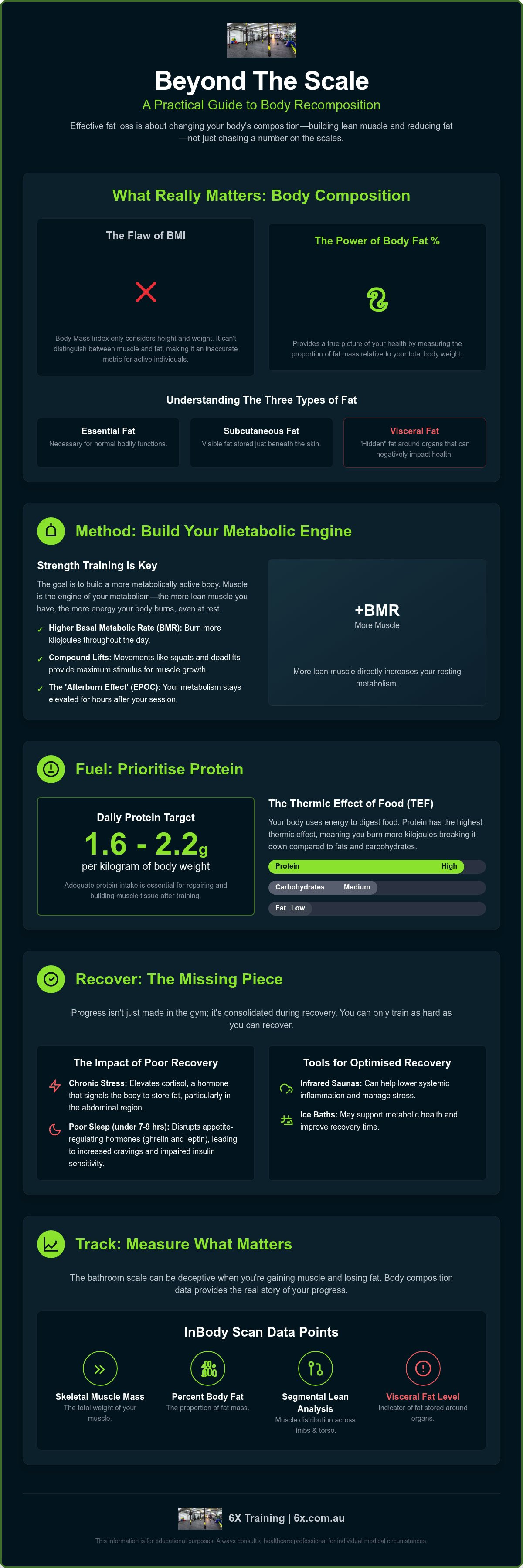
Improving your Body fat percentage isn’t about chasing a lower number on the bathroom scales. It’s about changing the composition of your body—increasing lean muscle while reducing fat mass. This process, often called ‘body recomposition’, is the key to achieving a stronger, leaner, and more athletic physique.
Unlike Body Mass Index (BMI), which can be a flawed metric for active individuals in Maroubra who carry more muscle, body fat percentage provides a far more accurate picture of your health and fitness. It distinguishes between three types of fat:
- Essential Fat: Necessary for normal bodily functions.
- Subcutaneous Fat: The visible fat stored just beneath the skin.
- Visceral Fat: The ‘hidden’ fat stored around your internal organs in the abdominal cavity. This type of fat is metabolically active and can negatively influence factors like insulin sensitivity when levels are high.
The ‘Skinny Fat’ Frustration
A common frustration is the ‘skinny fat’ physique, where someone has a low body weight but lacks muscle definition and carries a higher-than-expected body fat percentage. This often occurs from focusing solely on calorie restriction and excessive cardio, which can lead to the loss of valuable muscle tissue along with fat. Without sufficient muscle, the body lacks the toned appearance many people are working towards. The most effective solution is a structured resistance training programme designed to build and maintain lean mass.
A Practical Method: Strength Training for Metabolic Health
To effectively lower your body fat percentage, the focus must shift from simply burning calories to building a more metabolically active body. Muscle tissue is the engine of your metabolism; the more lean muscle you have, the more energy your body burns at rest. This is known as your Basal Metabolic Rate (BMR).
A well-structured Strength training programme is the most efficient way to build this muscle. Compound movements like squats, deadlifts, and presses engage multiple muscle groups simultaneously, providing the stimulus needed for muscle growth. These intense sessions also create a significant ‘afterburn effect’ (known as EPOC or excess post-exercise oxygen consumption), where your metabolism remains elevated for hours after your workout is finished.
For many people in the Eastern Suburbs, from Coogee to Randwick, finding the time and knowledge to execute this properly can be a challenge. Working with a coach ensures every session has the right intensity and technique to drive change, helping you build the lean tissue that provides the ‘toned’ look most people desire. Our personalised training programmes are built around this principle.
Protein: The Foundational Nutrient for Fat Loss
Nutrition is the other half of the equation. While all macronutrients require energy to be digested (the Thermic Effect of Food, or TEF), protein has the highest thermic effect. This means your body uses more energy to break down protein compared to fats and carbohydrates. More importantly, adequate protein intake is essential for repairing and building muscle tissue after training.
A practical guideline for individuals looking to improve body composition is to aim for 1.6 to 2.2 grams of protein per kilogram of body weight each day. Hitting this target consistently can be challenging, which is where structured guidance helps. For those needing a clear plan, our nutrition coaching programme provides the framework to align your eating habits with your training goals.
Recovery: How Sleep and Stress Impact Fat Loss
Your progress is not just made in the gym; it’s consolidated during recovery. Chronic stress and poor sleep can actively work against your fat loss efforts by disrupting key hormones. When you’re persistently stressed, your body produces excess cortisol, a hormone that can signal the body to store fat, particularly in the abdominal region.
Similarly, a lack of quality sleep (ideally 7-9 hours per night) interferes with the hormones that regulate appetite—ghrelin (the hunger hormone) and leptin (the satiety hormone). This can lead to increased cravings and make it harder to stick to your nutrition plan. It also impairs insulin sensitivity, making it more difficult for your body to manage blood sugar effectively.
This is why relentlessly ‘smashing yourself’ with high-intensity workouts without adequate rest can backfire. At 6X, our philosophy is simple: you can only train as hard as you can recover. A holistic approach that balances effort with strategic rest is essential for long-term success.
Optimising Recovery in Maroubra
To support this balance, we’ve integrated recovery tools directly into our Maroubra studio. Modalities like infrared saunas can help lower systemic inflammation, while ice baths may support metabolic health. Incorporating these tools into your weekly routine can help manage stress, improve sleep quality, and ensure your body is ready for your next training session. You can learn more about our recovery services like infrared saunas and ice baths and how they fit into a complete programme.
Tracking Your Progress: Why You Need Body Composition Data
If you’re gaining muscle and losing fat, the number on the bathroom scale can be incredibly deceptive. It doesn’t differentiate between fat, muscle, water, and bone. Daily weight fluctuations caused by hydration, glycogen stores, and inflammation can mask genuine progress, leading to frustration and a loss of motivation.
This is why we use an InBody 570 scanner at our Maroubra studio. It provides a detailed analysis of your body composition, including:
- Skeletal Muscle Mass: The total weight of your muscle.
- Percent Body Fat: The proportion of fat mass relative to your total body weight.
- Segmental Lean Analysis: A breakdown of muscle distribution across your arms, legs, and torso.
- Visceral Fat Level: An indicator of the fat stored around your organs.
At our Maroubra studio, we use the InBody 570 not just for a single snapshot, but to track trends over time. For example, if we see a member's Skeletal Muscle Mass increasing while their Percent Body Fat is dropping, we know their training and nutrition programme is working, even if the scale hasn't moved much. This data allows us and our members to make informed adjustments, ensuring they continue making progress towards their goals.
Tracking these metrics every 4-8 weeks provides objective feedback and helps you focus on what truly matters—building a healthier body composition. It moves the focus from weight to non-scale victories like improved strength, better-fitting clothes, and more energy.
Start Your Transformation: Personal Training in Maroubra
Improving your body fat percentage requires a structured, consistent, and data-driven approach. It combines effective strength training, supportive nutrition, and intelligent recovery. A private studio environment provides the focus and accountability needed to bring these elements together, away from the distractions of a crowded commercial gym.
Having a coach ensures you maintain proper form, progress your workouts safely, and stay committed when motivation wavers. The psychological benefit of a scheduled appointment and a clear plan removes the guesswork, allowing you to focus on your effort.
If you are ready to move beyond the scale and understand what’s truly happening with your body, the first step is to get accurate data. We invite you to book an InBody scan at our Maroubra studio to establish your baseline and discuss a personalised plan for your goals.
Please note: The information in this article is for educational purposes only. Always consult with a qualified healthcare professional before beginning any new diet or exercise programme, especially if you have pre-existing health conditions.
Article by
Brad Ellison
Brad Ellison is a personal trainer, weight loss coach and founder of 6X Training in Maroubra, Sydney. Since 2006, he has helped clients across the Eastern Suburbs lose weight, build strength and improve their health through personalised fitness coaching, nutrition support and accountability. His expertise includes fat loss, body composition improvement, strength training and sustainable lifestyle change.
General Health Disclaimer
This article is general information only and does not replace individual medical, allied health or nutrition advice. 6X Training coaches are personal trainers, not physiotherapists, dietitians, exercise physiologists or other healthcare practitioners. If you have an injury, chronic health condition, disability or you're unsure whether exercise is appropriate for you, please speak with your GP or a qualified healthcare professional before starting a new training or nutrition programme. NDIS participants should confirm funding and plan details with their support coordinator or plan manager.